
Choosing between Company Registration and LLP Registration isn’t only a business decision – it’s fundamentally a legal one. Each structure is governed by a separate statute, carries a different liability framework for its owners, follows distinct rules for foreign investment, and has its own exit and dissolution mechanism. Founders and professionals who treat this as a purely commercial choice often discover the legal consequences only after incorporation – when changing course becomes expensive.
A Private Limited Company is incorporated under the Companies Act, 2013, while an LLP is governed by the Limited Liability Partnership Act, 2008. Both create a separate legal entity distinct from their owners, but the statutory obligations, personal liability exposure, and regulatory oversight attached to each are meaningfully different – and that difference matters more the longer your business operates.
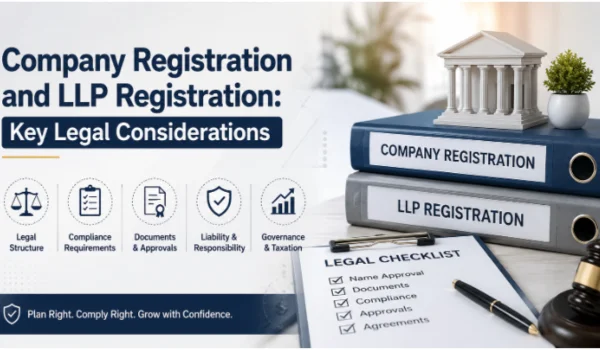
Governing Legal Framework: The First Consideration
Company Registration is governed by the Companies Act, 2013, while LLP Registration is governed by the Limited Liability Partnership Act, 2008 – and this single distinction shapes every other legal obligation that follows.
Private limited company registration involves incorporating an entity defined under Section 2(68) of the Companies Act, 2013. Regulated by the Ministry of Corporate Affairs (MCA) through the Registrar of Companies (RoC), the registration is completed via the integrated SPICe+ (INC-32) form on the MCA V3 portal.
An LLP is created under the LLP Act, 2008, filed through the FiLLiP form, and is also regulated by the MCA – but with a materially lighter statutory framework, closer in spirit to partnership law than corporate law.
Legal Personality and Liability Protection
Both structures grant separate legal personality – the entity can own property, enter contracts, sue, and be sued in its own name, independent of its owners. Both also offer limited liability, meaning personal assets of shareholders or partners are generally shielded from business debts.
However, the legal basis for that protection differs:
- Company: A shareholder’s liability is limited to the unpaid amount on their shares. Directors additionally owe fiduciary duties to the company under Sections 166 and related provisions of the Companies Act, and can face personal liability for fraud, misfeasance, or specific statutory defaults (such as failure to file returns or non-payment of statutory dues).
- LLP: A partner’s liability is limited to their agreed contribution to the LLP, as set out in the LLP Agreement. Designated partners bear specific statutory responsibility for compliance filings (Form 8, Form 11) and can face personal liability in cases of fraud or wrongful trading, but the enforcement framework around this is comparatively lighter than for company directors.
Legal nuance: Neither structure protects owners from liability arising out of personal guarantees, fraud, or wrongful acts – a fact many founders overlook when assuming “limited liability” means unconditional protection.
Governance Documents: MOA/AOA vs LLP Agreement
| Legal Aspect | Private Limited Company | LLP |
| Governing Document | Memorandum of Association (MOA) + Articles of Association (AOA) | LLP Agreement |
| Filing Requirement | Filed at incorporation via SPICe+ | Filed within 30 days of incorporation |
| Amendment Process | Requires special resolution + ROC filing (Form MGT-14) | Requires filing Form 3 with the RoC |
| Governs | Objects, share capital, internal regulations, director powers | Profit-sharing, management rights, partner duties, dispute resolution |
| Default Rules if Absent | AOA defaults to Table F of the Companies Act, 2013 | First Schedule of the LLP Act applies if no agreement is filed |
| Flexibility | Relatively rigid – governed by statutory templates | Highly flexible – largely contractual between partners |
Legal consideration: An LLP Agreement is a contract, giving partners significant freedom to define management structure, profit-sharing ratios, and exit terms. A company’s AOA, by contrast, must operate within statutory boundaries set by the Companies Act – offering less contractual flexibility but more standardised investor protections, which is one reason institutional investors prefer the company structure.
Foreign Ownership and FEMA Considerations
Foreign investment rules differ meaningfully between the two structures, and this is a critical legal consideration for startups anticipating international investors or founders.
- Private Limited Company: Foreign nationals and entities can hold shares, subject to compliance with the Foreign Exchange Management Act (FEMA) and the FDI Policy. 100% FDI is permitted under the automatic route in most sectors, meaning no prior government approval is needed – only post-investment reporting to the RBI.
- LLP: FDI is permitted only in sectors where 100% FDI is allowed under the automatic route, making LLPs structurally more restrictive for foreign investment than companies. Non-resident partners must also comply with FEMA reporting requirements, including filing Form FDI-LLP (I) and (II) with the RBI within 30 days of receiving foreign capital contribution.
Regulatory Oversight and Dispute Resolution
A lesser-discussed but important legal consideration is how disputes and insolvency are handled under each structure.
- Company: Disputes involving companies – including oppression and mismanagement, insolvency, and restructuring – are adjudicated by the National Company Law Tribunal (NCLT), established under the Companies Act. Insolvency proceedings follow the Insolvency and Bankruptcy Code, 2016 (IBC), with a well-developed procedural framework.
- LLP: There is no equivalent tribunal structure specifically for LLPs. LLP-related disputes and insolvency mechanisms remain comparatively underdeveloped in India’s legal system, which can mean more uncertainty and reliance on general contract or partnership law principles when disputes arise between partners.
Legal Consequences of Non-Compliance
| Non-Compliance Scenario | Private Limited Company | LLP |
| Late filing of annual return | Additional fees + penalty per day of default | ₹100 per day of delay, with no maximum cap |
| Failure to file LLP Agreement within 30 days | Not applicable | ₹100 per day of delay, uncapped |
| Failure to conduct statutory audit | Penalty under the Companies Act; director liability possible | Penalty applicable if turnover/contribution thresholds are breached and audit skipped |
| Continued non-filing over multiple years | RoC may strike off the company under Section 248 | RoC may strike off the LLP; directors/partners may face disqualification |
| Fraudulent conduct | Directors face personal liability, prosecution under the Companies Act | Designated partners face personal liability under the LLP Act |
Common Mistake: Many founders assume that if a company or LLP is dormant, no compliance is required. Legally, this is incorrect – NIL filings are still mandatory, and penalties continue to accrue for missed filings even when there’s no business activity.
Case Study: A defunct Private Limited Company that failed to file annual returns for two consecutive financial years became eligible for suo-motu strike-off by the RoC under Section 248, illustrating how continued non-compliance – even without active business – carries real legal consequences, including potential director disqualification.
Legal Process for Conversion
An LLP can be converted into a Private Limited Company under specific conditions laid down in the Companies Act, 2013 – a common legal step for LLPs that later decide to raise equity funding. The reverse conversion (company to LLP) is also legally possible but comes with its own tax and regulatory conditions, particularly around unlisted status and shareholding patterns.
Legal consideration: Conversion is not instantaneous – it involves fresh filings, transfer of assets and liabilities, creditor consent in some cases, and updated statutory registrations (PAN, GST, bank accounts). Businesses should treat conversion as a legal project, not an administrative formality.
Exit and Winding-Up: Legal Routes Compared
| Exit Route | Private Limited Company | LLP |
| Voluntary Strike-Off (Inactive Entity) | Form STK-2 under Section 248(2), with Forms STK-3 and STK-4 | Form 24, for LLPs inactive for at least 1 year |
| Formal Winding Up (Active Entity with Liabilities) | Voluntary liquidation with liquidator appointment + NCLT application | Winding up through NCLT, though the framework is less developed than for companies |
| Eligibility for Strike-Off | No business activity for the two preceding financial years | No operations or liabilities for at least one year |
| Post-Dissolution Status | Entity ceases to exist; compliance obligations end | Entity ceases to exist; compliance obligations end |
Conclusion
The legal considerations behind Company Registration and LLP Registration run far deeper than tax rates or filing fees. From the statute that governs your entity, to how liability attaches to directors or partners, to how foreign investment and disputes are handled, each structure carries distinct legal weight that shapes your business for years to come. Founders who evaluate these legal dimensions upfront – rather than defaulting to whichever structure a peer chose – are far better positioned to avoid compliance penalties, ownership disputes, and costly conversions down the line.
Given the statutory complexity involved, it’s worth having qualified legal and compliance professionals assess your specific situation before you file with the MCA.
Why Choose Zolvit
- Expert lawyers and Company Secretaries who evaluate the legal implications of each structure for your business
- CA support for tax and compliance planning across both company and LLP frameworks
- Fast, accurate processing with dedicated MCA filing specialists
- Affordable, transparent pricing with no hidden charges
- End-to-end compliance – from incorporation through annual filings, conversion, or closure
- Dedicated support at every legal milestone of your business
Not sure which legal structure fits your business? Talk to a Zolvit expert today for a personalised assessment of the legal considerations behind Company Registration and LLP Registration.
Frequently Asked Questions
1. Does limited liability protect directors or partners from all business debts?
Limited liability protects personal assets from ordinary business debts, but does not cover liability arising from fraud, wrongful trading, personal guarantees, or specific statutory defaults under the Companies Act or LLP Act.
2. Can a foreign national be a partner in an Indian LLP?
YES. Foreign nationals and foreign LLPs can become partners in an Indian LLP, provided at least one designated partner is a resident of India, and all FEMA reporting requirements, including Form FDI-LLP filings, are complied with.
3. Is an LLP Agreement legally mandatory?
YES. An LLP Agreement must be filed within 30 days of incorporation. If no agreement is filed, the default provisions under the First Schedule of the LLP Act, 2008 automatically apply, which may not reflect the partners’ actual intentions.
4. Can a dormant company or LLP avoid annual compliance filings?
Even dormant or inactive companies and LLPs must file NIL annual returns and financial statements. Skipping filings, regardless of business activity, attracts penalties and can lead to strike-off by the Registrar.
5. Is NCLT approval required to close every company?
Inactive companies with no liabilities can be closed through the simplified Form STK-2 strike-off process. NCLT involvement is required only for formal winding up of companies with outstanding debts or unresolved legal proceedings.