
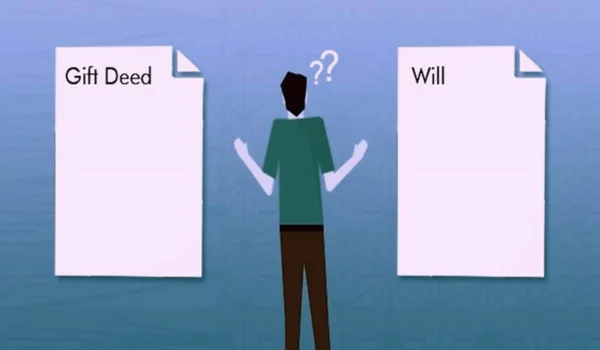
A Will and a Gift Deed are two common legal methods for transferring property in India. While both allow a person to pass on assets to others, they work very differently. A Gift Deed transfers ownership during the owner’s lifetime, whereas a Will takes effect only after the owner’s death.
Choosing the right option depends on your financial goals, family situation, and legal requirements.
Disclaimer: This article is for general information only and should not be considered legal advice.
Will vs Gift Deed: Quick Comparison
| Feature | Will | Gift Deed |
| When It Takes Effect | After the owner’s death | Immediately after registration |
| Ownership Transfer | After death | During the donor’s lifetime |
| Registration | Optional (recommended) | Mandatory for immovable property |
| Stamp Duty | Generally not applicable | Applicable as per state laws |
| Revocation | Can be changed or revoked anytime before death | Generally irrevocable after registration |
| Consideration | No | No |
| Applicable Law | Indian Succession Act, 1925 | Transfer of Property Act, 1882 & Registration Act, 1908 |
What Is a Will?
A Will is a legal document through which a person (called the testator) states how their property and assets should be distributed after their death.
Key features:
- Takes effect only after the testator’s death.
- Can be modified or revoked during the testator’s lifetime.
- Registration is optional but recommended for better evidentiary value.
- The owner retains complete control over the property during their lifetime.
What Is a Gift Deed?
A Gift Deed is a legal document used to transfer property voluntarily from one person (the donor) to another (the donee) without receiving any payment.
Key features:
- Ownership transfers immediately after registration.
- Registration is mandatory for immovable property.
- The donee becomes the legal owner once the gift is completed.
- The donor generally cannot revoke the gift except in limited legal circumstances.
Key Differences Between a Will and a Gift Deed
- Time of Transfer
Will
The property is transferred only after the owner’s death.
Gift Deed
Ownership is transferred immediately after the Gift Deed is registered.
- Ownership Rights
Will
The owner continues to own and control the property during their lifetime.
Gift Deed
The donor loses ownership rights once the gift is legally completed.
- Registration
Will
Registration is optional under Indian law, although it may help reduce future disputes.
Gift Deed
Registration is mandatory for transferring immovable property.
- Stamp Duty
Will
Generally, no stamp duty is payable for executing a Will.
Gift Deed
Stamp duty and registration fees must be paid according to the applicable state laws.
- Revocation
Will
A Will can generally be changed or cancelled at any time before the testator’s death.
Gift Deed
A registered Gift Deed is generally irrevocable, except in limited situations such as mutual agreement or a court order on valid legal grounds.
When Should You Choose a Will?
A Will may be suitable if you:
- Want to retain ownership during your lifetime.
- Wish to change your decisions later if circumstances change.
- Want to distribute property among multiple legal heirs.
- Prefer a flexible estate planning tool.
When Should You Choose a Gift Deed?
A Gift Deed may be suitable if you:
- Want to transfer property immediately.
- Wish to gift property to your children or spouse during your lifetime.
- Want the recipient to become the legal owner without waiting for succession.
- Are comfortable giving up ownership rights.
Tax Implications
Will
- Inheriting property through a Will generally does not attract income tax for the beneficiary.
- Future tax liabilities may arise if the inherited property is later sold.
Gift Deed
- Gifts from specified relatives are generally exempt from income tax under the Income-tax Act.
- Gifts from non-relatives may be taxable if they exceed the prescribed limits, unless an exemption applies.
- Stamp duty is generally payable on the registration of a Gift Deed.
Pros and Cons
Will
Pros
- Owner keeps full control during their lifetime.
- Can be revised or revoked.
- No stamp duty for execution.
- Suitable for estate planning.
Cons
- Property transfers only after death.
- May be challenged in court under certain circumstances.
- Probate may be required in some cases.
Gift Deed
Pros
- Immediate transfer of ownership.
- Reduces future succession disputes.
- Legally effective after registration.
- Suitable for lifetime transfers.
Cons
- Stamp duty and registration charges apply.
- Generally cannot be revoked.
- Donor permanently gives up ownership.
FAQs
Which is better: a Will or a Gift Deed?
It depends on your objective. A Will is better if you want to retain ownership during your lifetime, while a Gift Deed is suitable if you want to transfer ownership immediately.
Is registration compulsory for a Will?
No. Registration is optional but recommended.
Is registration compulsory for a Gift Deed?
Yes. Registration is mandatory for gifting immovable property.
Can a Gift Deed be cancelled?
A registered Gift Deed is generally irrevocable and can be cancelled only in limited situations recognized by law.
Conclusion
Both a Will and a Gift Deed are effective legal tools for transferring property, but they serve different purposes. A Will offers flexibility and allows you to retain ownership until your death, while a Gift Deed transfers ownership immediately during your lifetime. Before choosing either option, consider factors such as family circumstances, tax implications, stamp duty, and long-term estate planning. For valuable property or complex family arrangements, consulting a qualified legal professional is advisable.