
An Encumbrance Certificate (EC) is an important property document that shows whether a property has any registered financial or legal liabilities, such as a mortgage, loan, or sale transaction, during a specific period. It is commonly required when buying or selling property, applying for a home loan, or verifying property ownership.
Many State Governments in India now allow citizens to apply for an Encumbrance Certificate online through their Registration Department portals.
This guide explains the eligibility, required documents, application process, fees, and how to download the certificate.
What Is an Encumbrance Certificate?
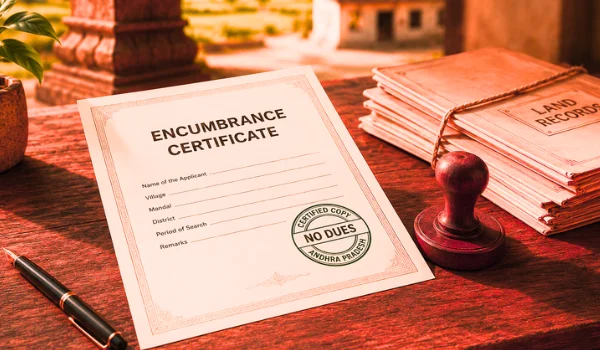
An Encumbrance Certificate (EC) is issued by the Sub-Registrar’s Office (SRO) or the Registration Department of the respective State Government. It records registered transactions relating to a property for the requested period.
The certificate helps buyers and lenders verify whether the property has any registered encumbrances.
Why Is an Encumbrance Certificate Required?
An EC is commonly required for:
- Buying or selling property
- Home loan applications
- Property title verification
- Property due diligence
- Loan against property
- Mutation of property records (in some states)
- Legal verification during property transactions
Who Can Apply?
Generally, anyone with a legitimate interest in the property can apply, including:
- Property owner
- Prospective buyer
- Legal heir
- Authorized representative
- Financial institution (where applicable)
Documents Required
The required documents vary by state, but generally include:
- Property details (Survey Number, Plot Number, or Document Number)
- Sale Deed or previous property document (if available)
- Applicant’s identity proof
- Address proof
- Application form
- Property registration details
- Applicable fee payment receipt
How to Apply for an Encumbrance Certificate Online
Step 1: Visit the State Registration Portal
Go to your State Government’s:
- Registration Department Portal
- Inspector General of Registration (IGR) website
- e-Registration Portal
Many states provide online EC search and download services.
Step 2: Select “Encumbrance Certificate”
Choose the Encumbrance Certificate (EC) service from the available list.
Step 3: Enter Property Details
Provide details such as:
- District
- Sub-Registrar Office
- Property Survey Number
- Document Number (if available)
- Property owner’s name
- Search period (From–To)
Ensure all details are entered correctly.
Step 4: Verify the Information
Review the property details carefully before proceeding.
Incorrect property information may result in an incorrect search or application.
Step 5: Pay the Applicable Fee
Pay the prescribed fee using available online payment methods such as:
- UPI
- Net Banking
- Debit/Credit Card
The fee varies by state and the search period requested.
Step 6: Download the Certificate
If online issuance is available, you can download the Encumbrance Certificate after processing.
In some states, you may need to collect the certificate from the Sub-Registrar’s Office.
Processing Time
The processing time varies by state but is generally between 1 and 7 working days for online applications. Offline applications may take longer.
What Information Does an EC Contain?
An Encumbrance Certificate may include:
- Property owner’s name
- Property description
- Registered sale transactions
- Mortgage details (if registered)
- Gift deeds
- Release deeds
- Lease deeds (where registered)
- Registration dates
- Document numbers
Limitations of an Encumbrance Certificate
An EC generally reflects only registered transactions. It may not show:
- Unregistered agreements
- Pending court cases
- Government acquisition notices
- Property tax dues
- Utility bill arrears
Therefore, an EC should be used along with other legal and title verification documents during property transactions.
Common Reasons for Application Rejection
Applications may be rejected due to:
- Incorrect property details
- Wrong survey or document number
- Incomplete application
- Non-payment of fees
- Mismatch in registration records
FAQs
Can I apply for an Encumbrance Certificate online?
Yes. Many State Governments provide online EC application and search facilities through their Registration Department portals.
Is an Encumbrance Certificate mandatory for a home loan?
Most banks and financial institutions require an EC during the home loan verification process, although additional property documents are also usually required.
How many years of EC should I obtain?
The required search period depends on the purpose. Buyers and lenders often request an EC covering several years, but the exact requirement varies by institution and transaction.
Does an EC prove ownership?
No. An Encumbrance Certificate does not by itself prove ownership. It only shows registered transactions affecting the property during the selected period. Title verification requires additional property documents.
Conclusion
An Encumbrance Certificate (EC) is one of the most important documents for verifying a property’s transaction history and checking for registered liabilities. Whether you are buying property, applying for a home loan, or confirming property records, obtaining an EC helps reduce legal risks. Before applying, check your State Registration Department’s official portal for the latest application process, fees, and document requirements.