
For many Indian families, financial peace of mind is not just about saving money — it is about having a stable monthly income. Whether you are a retiree, senior citizen, homemaker, or conservative investor, receiving predictable income every month can make budgeting easier and reduce financial stress.
That’s exactly why Monthly Income Fixed Deposit (FD) Schemes remain highly popular in India.
Unlike regular fixed deposits where interest is paid at maturity, monthly income FDs provide regular monthly payouts directly into your bank account. This makes them especially useful for people who:
- depend on passive income,
- want safer returns,
- or need consistent cash flow without taking stock market risk.
But here’s the important question:
Which monthly income FD scheme is actually best in India?
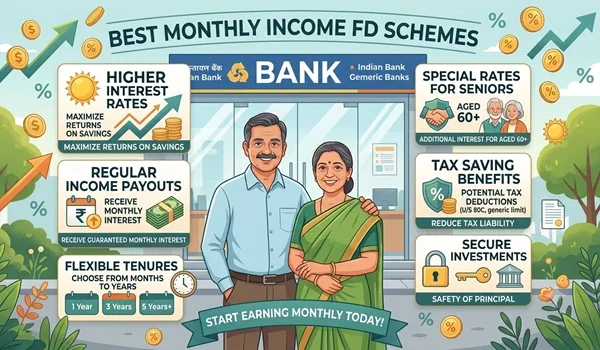
The answer depends on:
- interest rates,
- bank safety,
- payout flexibility,
- taxation,
- and your income needs.
In this detailed guide, we’ll explain everything about monthly income FD schemes, compare top banks, and help you choose the right option for stable monthly earnings.
What Is a Monthly Income FD Scheme?
A Monthly Income FD is a type of fixed deposit where:
- you invest a lump sum amount,
- and the bank pays interest every month instead of reinvesting it.
This is also called:
- non-cumulative FD,
- monthly payout FD,
- or interest payout FD.
Example
Suppose:
- you invest ₹10 lakh,
- at 7.2% interest,
- in a monthly payout FD.
Instead of receiving interest at maturity, you receive monthly income credited to your account.
This creates a steady income stream.
Why Monthly Income FDs Are Popular in India
Monthly income FDs are especially attractive because they combine:
- safety,
- simplicity,
- and regular cash flow.
Unlike mutual funds or stocks:
- there is no daily market volatility,
- no complex monitoring,
- and returns are mostly predictable.
This makes them ideal for:
- retirees,
- senior citizens,
- conservative investors,
- pensioners,
- and people seeking low-risk passive income.
Best Monthly Income FD Schemes in India 2026
Here’s a comparison of some of the popular monthly income FD options available in India.
| Bank / Institution | Approx FD Rate | Senior Citizen Rate | Best For |
| SBI Monthly Income FD | 6.75%–7.00% | Up to 7.50% | Safety and trust |
| HDFC Bank FD | 7.00%+ | Higher senior rates | Premium banking |
| ICICI Bank Monthly FD | 6.90%–7.10% | Better senior returns | Digital convenience |
| Axis Bank FD | Up to 7.25% | Up to 7.75% | Flexible payout |
| IDFC FIRST Bank | Up to 7.50% | Around 8% | Better private bank returns |
| Yes Bank FD | Up to 8% | Higher senior rates | High-income seekers |
| Jana Small Finance Bank | Up to 8.50%+ | Higher senior benefits | Maximum payout |
| Unity Small Finance Bank | Above 9% on select tenures | Very high senior rates | Aggressive investors |
| Post Office MIS | Stable government-backed returns | Same for seniors | Ultra-safe investors |
Rates change regularly depending on RBI policies and market conditions.
Who Should Invest in Monthly Income FDs?
This investment option is suitable for people who prioritize:
- regular income,
- stability,
- and capital protection.
- Senior Citizens
This is the biggest investor category.
Retirees often use monthly income FDs to:
- supplement pensions,
- cover household expenses,
- and maintain financial independence.
Many banks also offer higher senior citizen interest rates.
- Conservative Investors
Some investors simply dislike market volatility.
For them:
- predictable monthly interest,
- fixed returns,
- and low risk
matter more than aggressive wealth creation.
- Homemakers and Families
Monthly FD payouts can support:
- household budgets,
- school fees,
- utility expenses,
- and medical costs.
- Investors Seeking Passive Income
People wanting stable cash flow without active investment management often prefer monthly FDs.
How Monthly Income FD Works
The process is simple.
Step 1
Deposit lump sum amount.
Step 2
Choose:
- monthly payout option,
- tenure,
- and interest credit account.
Step 3
Bank pays monthly interest into your savings account.
Step 4
At maturity:
- principal amount is returned.
Unlike cumulative FDs:
- interest does not compound significantly because it is withdrawn regularly.
Monthly Income FD vs Regular FD
Many investors confuse the two.
| Feature | Monthly Income FD | Regular Cumulative FD |
| Interest Payout | Monthly | At maturity |
| Compounding | Limited | Strong |
| Monthly Cash Flow | Yes | No |
| Wealth Growth | Moderate | Better long-term |
| Best For | Income seekers | Long-term savers |
| Liquidity | Moderate | Moderate |
If your goal is:
- regular income → choose monthly FD.
- long-term wealth growth → cumulative FD may work better.
How Much Monthly Income Can You Earn?
This depends on:
- deposit amount,
- interest rate,
- and tenure.
Example Calculation
Suppose:
- investment = ₹15 lakh,
- interest rate = 7.5%.
Estimated annual interest:
- ₹1,12,500.
Approx monthly income:
- around ₹9,000+ before taxes.
For retirees, this predictable income can significantly help manage monthly expenses.
Which Bank Is Best for Monthly Income FD?
The answer depends on your priorities.
SBI Monthly Income FD
Best For:
- maximum trust,
- retirees,
- conservative investors.
Advantages
- strong credibility,
- nationwide branch network,
- stable service.
Drawback
- slightly lower rates than small finance banks.
HDFC & ICICI Bank FDs
Best For:
- urban investors,
- digital banking users,
- convenience seekers.
Advantages
- easy online management,
- good customer service,
- flexible tenure choices.
Small Finance Bank FDs
Best For:
- investors prioritizing higher monthly payouts.
These banks often provide:
- 8% to 9%+ interest,
- attractive senior citizen benefits.
Important Warning
Higher returns usually come with slightly higher perceived risk.
Always diversify large deposits.
Important FD Safety Rule
Many investors focus only on interest rates and ignore safety.
DICGC Insurance
Bank deposits are insured up to:
₹5 lakh per depositor per bank.
That means:
- large deposits should ideally be split across banks.
This is especially important when investing in small finance banks for higher returns.
Monthly Income FD vs Post Office Monthly Income Scheme (MIS)
This comparison is very common among retirees.
| Feature | Monthly Income FD | Post Office MIS |
| Safety | High | Government-backed |
| Interest Rate | Varies by bank | Fixed government rate |
| Monthly Income | Yes | Yes |
| Liquidity | Moderate | Limited |
| Return Potential | Can be higher | Stable |
| Best For | Flexible investors | Conservative retirees |
Post Office MIS is preferred by ultra-conservative investors seeking government-backed assurance.
Taxation on Monthly Income FD
This is one area many investors underestimate.
Monthly FD Interest Is Taxable
Interest earned is added to your taxable income.
If you are in:
- 20% or 30% tax slab,
your effective returns reduce considerably.
How to Reduce Tax Burden Legally
- Use Senior Citizen Benefits
Higher rates improve net earnings.
- Submit Form 15G/15H
If eligible.
- Split Investments Across Family Members
Can improve tax efficiency.
- Diversify with Other Investments
Avoid depending entirely on taxable interest income.
Biggest Advantages of Monthly Income FD
- Predictable Cash Flow
Ideal for budgeting.
- Low Risk
Compared to equity investments.
- Easy to Understand
No market tracking needed.
- Better Financial Discipline
Regular income without touching principal.
- Senior Citizen Friendly
Higher interest benefits available.
Biggest Drawbacks of Monthly Income FD
- Inflation Risk
Returns may not beat inflation over long periods.
- Taxation
Interest is fully taxable.
- Lower Wealth Creation
Compared to equity investments.
- Limited Compounding
Monthly payouts reduce compounding effect.
Smart Strategy for Retirees
Many financial planners recommend a balanced approach.
Example:
- emergency fund in savings account,
- monthly income through FD,
- long-term growth through mutual funds,
- government-backed schemes for stability.
This combination helps:
- maintain income,
- preserve capital,
- and improve long-term financial security.
Common Mistakes Investors Should Avoid
- Chasing Only Highest FD Rates
Safety matters too.
- Investing Entire Retirement Corpus in One Bank
Diversification is essential.
- Ignoring Tax Impact
Post-tax return matters more than headline rate.
- No Emergency Liquidity
Always keep accessible funds.
- Depending Only on FD
Inflation protection is important.
Is Monthly Income FD Better Than Mutual Funds?
It depends on your goal.
Choose Monthly Income FD If:
- stability matters most,
- you need predictable cash flow,
- you dislike market volatility.
Choose Mutual Funds If:
- you want long-term growth,
- inflation-beating returns,
- and can tolerate some risk.
For many retirees, combining both works best.
Final Verdict
Monthly income FD schemes remain one of the most practical and trusted investment options in India for people seeking regular income with low risk.
Their biggest strengths are:
- simplicity,
- stability,
- predictable payouts,
- and capital protection.
For senior citizens and conservative investors, they can play a critical role in maintaining financial independence after retirement.
However, investors should also understand the limitations:
- taxable interest,
- inflation risk,
- and slower wealth growth compared to market-linked investments.
The smartest strategy in 2026 is balance:
- use monthly income FDs for stable cash flow,
- diversify across trusted banks,
- maintain emergency liquidity,
- and combine FDs with growth-oriented investments where suitable.
At the end of the day, the best monthly income plan is not just about earning the highest interest rate — it is about creating sustainable financial comfort and peace of mind.