
If you are searching for the best FD rates in India today, you are probably asking one simple question: “Where can I safely park my money and still earn decent returns?”
The good news is that fixed deposits (FDs) are still one of the most trusted investment options in India, especially for conservative investors, retirees, salaried professionals, and people building an emergency fund. The even better news? Some banks are currently offering FD interest rates above 8% for select tenures.
But here’s the catch — not every high FD rate is automatically the best choice. You must compare:
- Interest rates
- Bank safety and credibility
- Tenure
- Premature withdrawal rules
- Senior citizen benefits
- Tax implications
- DICGC insurance coverage
Let’s break everything down in a practical and easy-to-understand way.
Why FD Rates Matter More in 2026
After multiple RBI policy changes and changing market conditions, banks are competing aggressively to attract deposits. That’s why many private banks and small finance banks are offering significantly higher FD returns compared to traditional PSU banks.
For investors who want:
- stable returns,
- low risk,
- predictable income,
- and capital protection,
FDs remain a strong option.
Unlike stock markets or mutual funds, FDs are not affected by daily volatility. You know exactly how much you will earn at maturity.
Best FD Rates in India Today – Top Banks Comparison
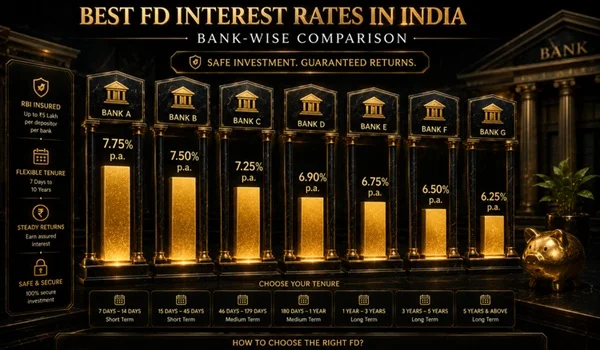
Here’s a simplified comparison of some of the best FD interest rates currently available in India for regular citizens.
| Bank Name | Highest FD Rate (Approx.) | Senior Citizen Rate | Best For |
| Jana Small Finance Bank | 8.20% | 8.70% | Highest returns |
| Unity Small Finance Bank | 8.60% | 9%+ on select schemes | Aggressive investors |
| Suryoday Small Finance Bank | 8.40% | 8.50%+ | Long-term FD investors |
| Utkarsh Small Finance Bank | 8.25% | 8.75% | High-yield deposits |
| Ujjivan Small Finance Bank | 8.05% | 8.55% | Balanced high returns |
| HDFC Bank | 6.50%–6.60% | 7%+ | Safety + convenience |
| ICICI Bank | 6.50%–6.70% | 7.10% | Trusted private bank |
| SBI | 6.05%–6.45% | 7.05% | Maximum trust factor |
| Yes Bank | Up to 7.00% | 7.50% | Better private bank rates |
| IDFC FIRST Bank | Up to 7.25% | 7.75% | Strong mid-sized bank |
Public Sector vs Private vs Small Finance Banks
This is where most investors get confused.
- Public Sector Banks (SBI, Bank of Baroda, PNB)
Pros
- Highest trust factor
- Government backing perception
- Good for senior citizens
- Safer for large deposits
Cons
- Lower interest rates
- Less aggressive FD offerings
Ideal for:
- retirees,
- conservative investors,
- emergency corpus.
- Private Banks (HDFC, ICICI, Axis, Kotak)
Pros
- Better FD rates than PSU banks
- Excellent digital banking
- Faster services
- Strong credibility
Cons
- Slightly lower rates than small finance banks
Ideal for:
- salaried professionals,
- families,
- medium-risk investors.
- Small Finance Banks (Jana, Unity, Ujjivan, Suryoday)
Pros
- Highest FD interest rates
- Attractive senior citizen bonuses
- Special tenure schemes
Cons
- Slightly higher perceived risk
- Lower brand trust than SBI/HDFC
Ideal for:
- yield-focused investors,
- laddered FD strategy,
- limited deposits within insurance limits.
Important FD Safety Rule Most Investors Ignore
Many people blindly invest in the highest-rate FD without understanding deposit insurance.
In India, bank deposits are insured up to ₹5 lakh per depositor per bank under DICGC insurance.
That means:
- If you invest ₹20 lakh in one small finance bank, only ₹5 lakh is insured.
- Smart investors spread money across multiple banks.
Smart Strategy
Instead of:
- ₹20 lakh in one bank,
consider:
- ₹5 lakh each in 4 banks.
This improves safety while still earning high returns.
Best FD Tenure Right Now
One major mistake investors make is choosing random FD durations.
The best tenure depends on interest-rate cycles.
Currently, many banks are offering their highest rates in:
- 12–24 months
- 2–3 years
- special maturity schemes
Long-term 10-year FDs often offer lower effective flexibility.
Recommended Approach
Short-term FD (6–12 months)
Good for:
- emergency funds,
- uncertain market conditions.
Medium-term FD (1–3 years)
Currently the sweet spot for returns.
Long-term FD (5+ years)
Useful mainly for:
- tax-saving FDs,
- retirement planning.
Tax on Fixed Deposits in India
This is another area where many people lose returns unknowingly.
FD Interest Is Taxable
Your FD interest is added to your income and taxed according to your slab.
For example:
- If you are in the 30% tax bracket,
- a 7.5% FD may effectively become around 5.2% post-tax.
TDS Rules
Banks deduct TDS if:
- interest exceeds the prescribed annual threshold.
Senior citizens get higher exemption limits.
How to Reduce Tax Legally
- Use Form 15G / 15H
If eligible.
- Split FDs Across Family Members
Useful for tax planning.
- Consider Tax-saving FDs
5-year lock-in option.
- Ladder Your FDs
Helps optimize yearly interest payouts.
FD Laddering: The Smart Investor Strategy
Professional investors rarely put all money into one FD.
They use FD laddering.
Example:
Instead of:
- ₹5 lakh in one 5-year FD,
do:
- ₹1 lakh in 1-year FD
- ₹1 lakh in 2-year FD
- ₹1 lakh in 3-year FD
- ₹1 lakh in 4-year FD
- ₹1 lakh in 5-year FD
Benefits:
- better liquidity,
- reduced reinvestment risk,
- flexibility if rates rise later.
This strategy works especially well in uncertain interest-rate environments.
Best FD Options for Senior Citizens
Senior citizens are currently getting some of the best risk-free returns available in India.
Many banks offer:
- extra 0.25% to 0.75% interest,
- monthly payout options,
- special senior citizen schemes.
Some small finance banks are offering above 8.5% for seniors on select tenures.
For retirees looking for predictable monthly income, this can be highly attractive compared to savings accounts.
Should You Choose FD or Mutual Funds?
This depends on your goal.
| Goal | Better Option |
| Capital safety | FD |
| Higher long-term growth | Mutual Funds |
| Emergency savings | FD |
| Retirement income | FD + SWP combination |
| Beating inflation | Equity Mutual Funds |
| Short-term parking | FD |
FDs are not designed to create massive wealth. They are designed to:
- preserve capital,
- generate stable income,
- reduce portfolio risk.
The smartest investors use both FDs and mutual funds together.
Biggest FD Mistakes to Avoid
- Chasing only highest interest rates
Safety matters too.
- Ignoring tax impact
Post-tax return is what actually matters.
- Locking all money for long periods
Always keep liquidity.
- Not comparing senior citizen rates
Huge missed opportunity.
- Investing above insured limits in one bank
Diversification is essential.
- Forgetting nomination
Always add nominees.
Which FD Is Best Right Now?
Here’s a practical breakdown:
Choose SBI or HDFC Bank if:
- safety matters most,
- you want hassle-free banking,
- you dislike risk.
Choose ICICI or IDFC FIRST if:
- you want balance between trust and returns.
Choose Small Finance Banks if:
- maximizing returns is your priority,
- you diversify deposits wisely,
- you stay within insurance limits.
Final Thoughts
The best FD rates in India today are no longer limited to traditional banks. Small finance banks are offering extremely attractive returns, sometimes above 8%, while large banks continue to provide stability and trust.
But smart investing is not only about the highest number.
The real goal should be:
- balancing safety and returns,
- reducing tax leakage,
- maintaining liquidity,
- and building a diversified financial plan.
For most investors in 2026, a combination strategy works best:
- keep core savings in trusted large banks,
- allocate limited surplus to high-yield small finance bank FDs,
- and avoid concentrating all money in one place.
That way, you enjoy both peace of mind and better returns.