
Founders often delay starting their business not because of a lack of ideas, but because the registration process feels confusing. These questions pile up quickly, and without a clear roadmap, many first-time entrepreneurs either delay registration or hand it off blindly to an agent without understanding what’s happening.
The truth is, private limited company registration follows a well-defined, sequential process, one that becomes far less intimidating once broken into clear steps. Understanding each stage not only helps you avoid delays and rejections but also ensures you stay compliant right from day one, rather than scrambling to fix issues after incorporation.
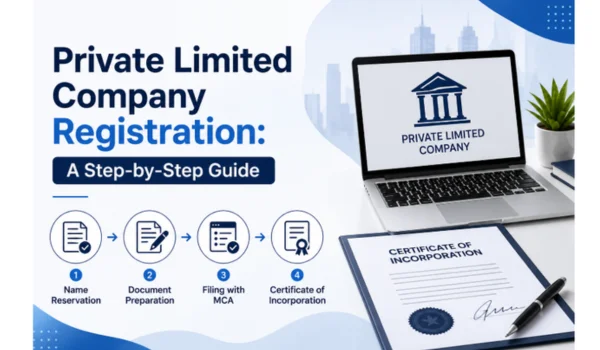
What Is Private Limited Company Registration?
Private limited company registration is the legal process of incorporating a business as a private limited company under the Companies Act, 2013, through the Ministry of Corporate Affairs (MCA).
The process results in a Certificate of Incorporation, a unique Corporate Identification Number (CIN), and automatic issuance of PAN and TAN, establishing the company as a separate legal entity with limited liability for its shareholders.
Step-by-Step Process for Private Limited Company Registration
Step 1: Obtain Digital Signature Certificates (DSC)
Every proposed director must obtain a DSC, as all incorporation forms are filed and signed electronically. This is typically the first step and can be completed within 1–2 days.
Documents needed: PAN, Aadhaar/passport, photograph, email ID, and mobile number of each director.
Step 2: Apply for Director Identification Number (DIN)
DIN is a unique identification number required for anyone acting as a director. For new companies, DIN is applied for directly within the incorporation form (SPICe+ Part B) rather than as a separate application.
Step 3: Reserve the Company Name
Using SPICe+ Part A, propose one or two company names in order of preference. The name must comply with MCA naming guidelines, it should not be identical or too similar to existing companies or trademarks, and must reflect the nature of the business where required.
Common Mistake: Choosing a name too similar to an existing trademark or registered company, leading to rejection and delays.
Step 4: Draft the MoA and AoA
The Memorandum of Association (MoA) defines the company’s objectives and scope of operations, while the Articles of Association (AoA) outlines internal governance rules, such as shareholder rights and decision-making processes.
Step 5: File SPICe+ Part B
This is the core incorporation form, capturing:
- Registered office address
- Details of directors and shareholders
- Share capital structure
- PAN and TAN application (auto-linked)
Documents needed: Address proof of registered office, NOC from property owner (if rented), identity and address proof of all directors/shareholders.
Step 6: RoC Verification and Approval
The Registrar of Companies (RoC) reviews the application and supporting documents. If everything is in order, the RoC approves the incorporation; if discrepancies are found, a resubmission request (RSUB) is issued.
Step 7: Receive Certificate of Incorporation
Once approved, the RoC issues the Certificate of Incorporation (COI), along with the company’s CIN, PAN, and TAN, officially marking the company’s legal existence.
Documents Required at Each Stage
| Stage | Documents Required |
| DSC Application | PAN, Aadhaar/Passport, photo, email, mobile number |
| Name Reservation | Proposed names, business activity description |
| SPICe+ Part B Filing | Registered office proof, NOC (if rented), director/shareholder ID and address proof |
| MoA/AoA Drafting | Business objectives, capital structure details |
Eligibility Requirements
| Requirement | Details |
| Minimum directors | 2 |
| Minimum shareholders | 2 |
| Resident director | At least 1 must reside in India |
| Minimum capital | No minimum requirement |
| Registered office | Valid address in India (owned or rented) |
Fees and Timeline
Time Taken: With accurate documentation, private limited company registration typically takes 7–10 working days. Delays usually stem from name rejections or incomplete documents.
Fees: Government fees vary based on authorised share capital and state of registration; professional fees depend on the service provider. Zolvit provides transparent, upfront pricing covering the entire process.
Common Mistakes That Cause Delays
- Submitting address proof older than the permitted validity period
- Choosing a company name that resembles an existing trademark or company
- Incomplete or mismatched director details across documents
- Delaying DSC applications, which pushes back the entire timeline
- Not preparing MoA/AoA objectives clearly, leading to RoC queries
What Happens Immediately After Registration?
Registration is only the beginning. Founders must complete several post-incorporation compliance steps to remain legally operational:
- Open a company bank account
- File Commencement of Business declaration (Form INC-20A) within 180 days
- Appoint a statutory auditor within 30 days
- Apply for GST registration, if applicable
- Issue share certificates to shareholders within 60 days
- Maintain statutory registers and board meeting minutes
Did You Know? Failing to file the Commencement of Business declaration (INC-20A) within the prescribed timeline can result in penalties and even removal of the company’s name from the RoC register.
Comparison: DIY Filing vs Professional Assistance
| Aspect | DIY Filing | Professional Assistance (Zolvit) |
| Time investment | High (self-research, error correction) | Low (guided process) |
| Risk of rejection | Higher | Significantly reduced |
| Post-registration compliance guidance | Not included | Included |
| Overall cost (including delays/rework) | Often higher due to resubmissions | Predictable, transparent |
Case Study
A first-time founder in Ahmedabad attempted private limited company registration independently, without professional guidance. Her initial application was rejected twice, once for a name conflicting with an existing trademark, and once for outdated address proof. After engaging Zolvit’s registration experts, the corrected application was filed within 2 days, and she received her Certificate of Incorporation within 8 working days, along with a clear compliance calendar for post-registration filings, avoiding the confusion that caused her initial delays.
Conclusion
Private limited company registration doesn’t need to be confusing when broken into clear, sequential steps, from obtaining DSCs and reserving a company name, to filing SPICe+ Part B and receiving the Certificate of Incorporation. Accuracy at each stage is critical, as even small document mismatches can lead to delays or rejections. Equally important is understanding that registration is just the starting point, post-incorporation compliance determines whether the company remains in good legal standing. Consulting experienced professionals can help founders navigate this process smoothly and avoid costly mistakes.
Why Choose Zolvit
- Expert lawyers and company secretaries managing each step precisely
- CA support for financial and tax structuring from day one
- Fast processing with proactive document verification
- Affordable, transparent pricing with no hidden charges
- End-to-end compliance support, including post-registration filings
- Dedicated support to answer questions at every stage
Skip the guesswork and register the right way. Start your private limited company registration with Zolvit’s step-by-step expert guidance today, book a consultation now.
FAQs
- Can I complete private limited company registration without visiting any government office?
YES. The entire process, from name reservation to receiving the Certificate of Incorporation, is completed online through the MCA portal, requiring no physical visits to government offices.
- Should I apply for DSC before choosing a company name?
YES, ideally. Applying for Digital Signature Certificates early ensures directors are ready to sign forms immediately once the company name is approved, preventing unnecessary delays in the process.
- What happens if my proposed company name gets rejected?
If a proposed name is rejected due to similarity with an existing company or trademark, you can resubmit alternative names through SPICe+ Part A, though this extends the overall registration timeline.
- Shall a company appoint an auditor immediately after registration?
YES. A newly incorporated company shall appoint a statutory auditor within 30 days of incorporation, as required under the Companies Act, 2013, to remain compliant.
- Can the registered office address be changed after private limited company registration?
YES. The registered office address can be changed after incorporation by filing the appropriate form with the RoC, though frequent changes without valid reason may attract scrutiny.