
For millions of retirees and senior citizens in India, financial security is not just about growing wealth — it is about preserving savings, earning stable income, and enjoying peace of mind after retirement. That is exactly why Senior Citizen Fixed Deposit (FD) Schemes remain one of the most trusted investment options in the country.
In 2026, banks and financial institutions are offering attractive senior citizen FD interest rates, with some schemes providing returns above 8% annually. Along with higher interest rates, these deposits also offer:
- predictable income,
- low risk,
- flexible payout options,
- and capital protection.
But here’s the challenge: with so many FD schemes available, many retirees get confused about:
- which bank offers the best rates,
- whether small finance banks are safe,
- how taxation works,
- and which tenure is ideal.
This detailed guide will help you understand the best senior citizen FD schemes in India, compare top options, and make smarter investment decisions for retirement income.
What Is a Senior Citizen FD Scheme?
A senior citizen FD is a special fixed deposit offered to individuals aged 60 years and above.
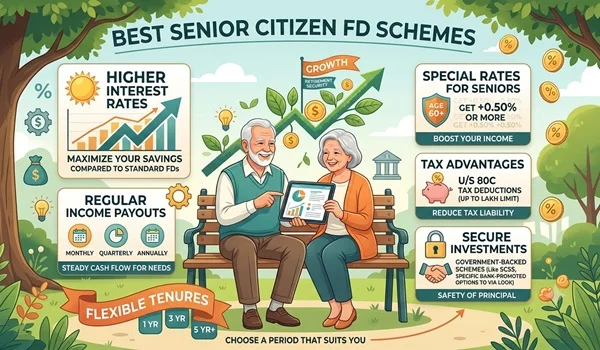
These schemes usually provide:
- additional interest rates compared to regular FDs,
- flexible interest payout options,
- better income planning,
- and special tenure benefits.
Most banks in India offer an extra:
- 0.25% to 0.75% interest
for senior citizens.
This difference may look small initially, but over time it can significantly improve retirement income.
Why Senior Citizens Prefer Fixed Deposits
Retirement changes financial priorities.
At a younger age, investors focus on:
- aggressive growth,
- equity markets,
- and long-term wealth creation.
But after retirement, the focus shifts toward:
- safety,
- predictable income,
- liquidity,
- and lower stress.
That is where FDs shine.
Unlike stock markets or high-risk investments, FDs provide certainty. Senior citizens know:
- how much they invest,
- how much interest they will earn,
- and when the money will mature.
This stability is extremely valuable during retirement years.
Best Senior Citizen FD Schemes in India 2026
Here’s a comparison of some of the popular senior citizen FD schemes currently available in India.
| Bank / Institution | Senior Citizen FD Rate (Approx.) | Best Tenure | Key Highlights |
| SBI WeCare | Up to 7.50% | 5–10 years | Trusted PSU bank scheme |
| HDFC Bank Senior FD | Up to 7.60% | 15–18 months | Strong private bank option |
| ICICI Bank FD | Up to 7.65% | 2–3 years | Good digital experience |
| Axis Bank Senior FD | Up to 7.75% | 15 months+ | Flexible payout options |
| IDFC FIRST Bank | Up to 8.00% | 400–500 days | Higher returns |
| Yes Bank Senior FD | Up to 8.25% | Special tenure | Attractive private bank rates |
| Jana Small Finance Bank | Up to 8.70% | 1–3 years | High-yield FD |
| Unity Small Finance Bank | Above 9% on select tenures | Long tenure | Among highest FD rates |
| Post Office Senior Citizen Savings Scheme (SCSS) | Around 8%+ | 5 years | Government-backed safety |
The rates keep changing depending on RBI policy and market conditions, so investors should always compare latest rates before investing.
SBI WeCare FD Scheme: A Popular Choice
One of the most well-known retirement FD products in India is the SBI WeCare Scheme.
Why is it popular?
Because it combines:
- SBI’s trust factor,
- additional senior citizen interest,
- and long-term safety.
Best Features
- Extra interest over regular FD rates
- Flexible investment tenure
- Monthly and quarterly payout options
- Trusted public sector banking network
For retirees who prioritize safety over aggressive returns, SBI WeCare remains a strong option.
Post Office Senior Citizen Savings Scheme (SCSS)
The Senior Citizen Savings Scheme (SCSS) deserves special attention because it is one of the safest retirement investment products in India.
Why SCSS Is Attractive
Government-backed security
Backed by the Government of India.
Quarterly income
Ideal for retirees needing regular cash flow.
Attractive interest rates
Usually higher than traditional savings accounts.
Tax benefits
Eligible for deductions under Section 80C.
Private Banks vs Small Finance Banks for Senior Citizens
This is one of the biggest dilemmas retirees face.
Private Banks
Examples:
- HDFC Bank
- ICICI Bank
- Axis Bank
Pros
- strong reputation,
- easy digital banking,
- good customer service,
- stable operations.
Cons
- slightly lower interest rates compared to small finance banks.
Small Finance Banks
Examples:
- Jana Small Finance Bank
- Unity Small Finance Bank
- Ujjivan Small Finance Bank
Pros
- highest FD interest rates,
- excellent returns for retirees,
- special senior citizen bonuses.
Cons
- relatively lower brand trust,
- investors worry more about safety.
Important Safety Rule for Senior Citizens
Many retirees unknowingly make a dangerous mistake:
they put all retirement savings into one bank because of slightly higher interest rates.
This is risky.
DICGC Insurance Rule
Bank deposits in India are insured up to ₹5 lakh per depositor per bank under DICGC coverage.
That means:
- if you deposit ₹25 lakh in one bank,
- only ₹5 lakh is insured.
Smart FD Diversification Strategy
Instead of:
- ₹20 lakh in one bank,
consider:
- ₹5 lakh each across multiple banks.
This improves safety while still allowing you to earn attractive returns.
This strategy is especially important when using small finance banks for higher rates.
Monthly Income vs Cumulative FD
Senior citizens should carefully choose the type of FD.
- Monthly Interest Payout FD
Best for:
- retirees needing regular income,
- pension supplementation,
- household expenses.
Pros
- stable monthly cash flow,
- easier budgeting.
Cons
- slightly lower compounding benefits.
- Cumulative FD
Interest compounds and is paid at maturity.
Best for:
- long-term savings,
- wealth preservation,
- legacy planning.
Pros
- higher maturity amount due to compounding.
Cons
- no regular income during tenure.
Which FD Tenure Is Best for Senior Citizens?
Choosing the wrong tenure can hurt liquidity and returns.
Short-Term FD (1 year or less)
Good for:
- emergency reserves,
- uncertain interest-rate environment.
Medium-Term FD (1–3 years)
Often provides the best balance between:
- returns,
- liquidity,
- and flexibility.
This is currently the sweet spot in many banks.
Long-Term FD (5+ years)
Best for:
- retirees seeking predictable long-term income,
- tax-saving options,
- and stability.
However, locking money for very long periods can reduce flexibility if interest rates rise later.
Taxation on Senior Citizen FDs
Many retirees focus only on interest rates and ignore taxes. This can reduce actual earnings significantly.
FD Interest Is Taxable
Interest earned from FDs is added to total income and taxed according to the applicable slab.
Tax Benefits Available for Senior Citizens
Section 80TTB
Senior citizens can claim deductions on interest income up to prescribed limits under Section 80TTB.
This is extremely helpful for retirees depending on interest income.
Form 15H
Eligible senior citizens can submit Form 15H to avoid unnecessary TDS deduction if taxable income falls below exemption limits.
FD Laddering: A Smart Retirement Strategy
Financial planners often recommend FD laddering for retirees.
What Is FD Laddering?
Instead of putting all money into one FD, divide investments across different maturities.
Example:
- ₹2 lakh in 1-year FD
- ₹2 lakh in 2-year FD
- ₹2 lakh in 3-year FD
- ₹2 lakh in 5-year FD
Benefits of FD Laddering
Better liquidity
Money becomes available periodically.
Reduced reinvestment risk
You can reinvest matured FDs at newer rates.
Flexible cash flow
Helpful during emergencies.
Better rate optimization
Avoids locking all funds at one interest cycle.
Common Mistakes Senior Citizens Should Avoid
- Chasing Only High Interest Rates
Safety should come first.
- Ignoring Inflation
Low returns may reduce purchasing power over time.
- Locking All Money in One FD
Always maintain liquidity.
- Not Adding Nominees
Very important for family convenience.
- Ignoring Health Emergency Funds
Never invest all retirement savings in locked deposits.
- Depending Only on FDs
Diversification matters even during retirement.
Should Senior Citizens Invest Only in FDs?
Not necessarily.
While FDs are excellent for stability, depending entirely on them may not beat inflation in the long run.
A balanced retirement portfolio may include:
- FDs,
- SCSS,
- debt mutual funds,
- annuity plans,
- and limited equity exposure depending on risk appetite.
The ideal mix depends on:
- age,
- health,
- monthly income needs,
- and existing pension sources.
Best FD Scheme Based on Investor Type
| Investor Type | Best Option |
| Maximum safety seeker | SBI WeCare / SCSS |
| Higher return seeker | Small Finance Bank FD |
| Monthly income need | Monthly payout FD |
| Tax-saving focus | 5-year tax-saving FD |
| Liquidity-focused retiree | Short-term FD ladder |
| Conservative investor | PSU Bank FD |
Final Thoughts
Senior citizen FD schemes continue to play a critical role in retirement planning across India. In a world where markets can fluctuate sharply, FDs provide something priceless to retirees — financial peace of mind.
The best senior citizen FD is not always the one offering the highest interest rate. The ideal scheme should balance:
- safety,
- regular income,
- liquidity,
- tax efficiency,
- and inflation protection.
For most retirees in 2026, a smart approach would be:
- keep core retirement savings in trusted banks or government-backed schemes,
- diversify deposits across institutions,
- use laddering for flexibility,
- and avoid concentrating all savings in one product.
Retirement investing is not about taking big risks. It is about creating stable income, protecting lifelong savings, and enjoying financial independence with confidence.