
The Tea Time franchise is one of India’s most affordable and fast-growing franchise opportunities in the beverage and café segment. With India being one of the world’s largest tea consumers, a branded tea café franchise like Tea Time offers a low-cost entry into the food & beverage business. This guide explains investment cost (INR), franchise fee & royalty, profit margin & ROI, space and manpower needs, franchisor support, pros & cons, application process, required documents, eligibility, risks, FAQs, and conclusion — all in simple and India-focused language.
🌱 What is a Tea Time Franchise?
Tea Time is a popular Indian tea-focused café brand with outlets that serve various Indian teas (like masala chai, ginger tea), coolers, milkshakes, and snacks. It targets youth, students, office-goers, and daily chai lovers through small-format kiosks or compact cafés. Tea Time’s franchise model is built for entrepreneurs seeking a low-investment business with relatively quick setup and steady demand.
💰 Tea Time Franchise Investment Cost (INR)
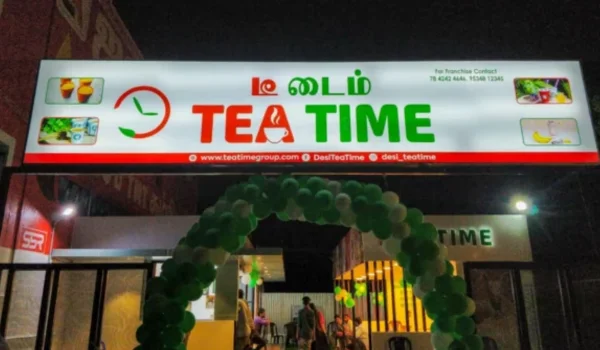
Tea Time is known for having one of the most affordable franchise costs in India’s café segment. Depending on location and outlet size, total investment ranges broadly but stays relatively low.
📌 Investment Breakdown
| Cost Component | Estimated Cost (₹) |
| Franchise / Brand Fee | ₹2,00,000 – ₹2,50,000 (one-time) |
| Store Setup & Interiors | ₹1,50,000 – ₹2,50,000 |
| Equipment & Machinery | ₹1,00,000 – ₹1,50,000 |
| Initial Inventory (Raw Material) | ₹50,000 – ₹1,00,000 |
| Licenses & Miscellaneous | ₹50,000 – ₹1,00,000 |
| Total Estimated Investment | ₹5,00,000 – ₹7,00,000 approx. |
✔ Low budget model: Small kiosk setups can start around ₹4.25 L – ₹6 L.
✔ Master franchise: Larger territorial rights or multi-unit ownership require higher investment (₹25 L+).
💡 Costs vary with city tier — metros and premium shopping areas require higher setup & rent than tier-2 and smaller towns.
🪙 Franchise Fee & Royalty
🧾 Franchise Fee
This is a one-time payment to the brand for using the Tea Time name and business model. It usually falls in the range of ₹2 L to ₹2.5 L.
💼 Royalty & Ongoing Charges
Many Tea Time franchise agreements include a royalty fee, often around 3% of monthly gross sales, usually with a capped amount (e.g., ₹9,000/month) to make it affordable for small-format business owners.
Some models mention an additional marketing contribution (e.g., 1% of monthly sales) to support brand promotions.
📈 Profit Margin & ROI
Tea cafés generally enjoy good margins due to low raw cost and high pricing appeal, especially in busy locations.
📊 Typical Financial Estimates
| Financial Metric | Expected Range |
| Gross Profit Margin | 40% – 60% |
| Average Monthly Revenue | ₹1,50,000 – ₹3,00,000 (smaller outlets) |
| Net Profit (After Expenses) | ₹50,000 – ₹1,20,000 per month approximately |
| Break-Even / ROI Period | 5 – 10 months |
🧠 Many Tea Time franchisees reportedly recover their initial investment within 6–10 months, especially in high-footfall areas like colleges, markets, transit hubs, or commercial streets.
⚠️ Note: These figures are indicative averages — actual performance depends on footfall, pricing, rent, operating cost, and management.
📍 Space & Manpower Needs
🏠 Space Requirement
Tea Time outlets are designed to work in compact spaces, which helps reduce rental costs. Standard requirements:
- 100 – 150 sq. ft. minimum space for kiosk or takeaway counter model.
- Options for slightly larger outlets (up to 250 sq. ft.) if seating is offered.
- Best locations include near colleges, markets, office areas, railway/bus stations, or near transit hubs.
👨🍳 Manpower Needs
- Typically 2–3 staff including a tea maker and a helper/cashier.
- Staff training provided by franchisor (usually on basic operations and hygiene).
- Owner involvement can reduce costs, especially in early months.
🧑💼 Franchisor Support
Tea Time brand often provides strong operational support, especially for small franchisees, including:
✔ Site selection assistance – guidance on choosing a high-footfall location.
✔ Store setup & branding support – layouts, signage, branding materials.
✔ Training for staff – covering tea preparation and service.
✔ Initial inventory & supply chain guidance – consistent raw material quality.
✔ Marketing support – brand campaigns during launch and beyond.
These supports help new entrepreneurs operate smoothly even without prior F&B experience.
📋 Application Process
Here is a typical Tea Time franchise application process in India:
- Initial Enquiry: Visit the Tea Time official franchise page or contact their franchising team with basic details (name, location, investment plan).
- Application Form: Fill the franchise application, including proposed outlet location and investment capability.
- Document Submission: Provide required legal and financial documents (listed below).
- Evaluation & Approval: Brand team reviews your profile and proposed site.
- Agreement & Fee: Sign the franchise agreement and pay the franchise fee.
- Store Setup: Work with the Tea Time team on setup, training, and launch.
- Go Live: Open your outlet and start business operations.
Typical setup time is 20–30 days from agreement to launch if all approvals are quick.
📑 Documents & Eligibility
🧾 Required Documents
- Aadhaar Card & PAN Card (identity proof)
- GST Registration
- Shop Act / Trade License
- FSSAI Food License (mandatory for food & beverage businesses)
- Bank statement / financial proof
- Lease agreement or property documents
👤 Eligibility Criteria
To qualify as a Tea Time franchisee, you should generally have:
✔ Financial capacity to invest ₹5 L+ (based on location)
✔ Access to required space in the chosen city
✔ Understanding of local market & customer preferences
✔ Willingness to learn operations and manage day-to-day work
✔ Basic business or retail management capability
No formal F&B experience is mandatory; training is usually provided.
⚖️ Pros & Cons
👍 Advantages
✔ Low initial investment compared to many café and QSR brands.
✔ Affordable space needs — ideal for smaller budgets.
✔ Rapid ROI potential (often within a year).
✔ Simple operations — mainly tea & quick snacks.
✔ Strong brand support — setup, supply chain, marketing.
✔ High margins on beverages — tea has low production cost.
👎 Disadvantages
✘ Royalty/fee obligations reduce net profit.
✘ Location matters a lot — poor footfall means slow sales.
✘ Competition from street stalls and local cafés can be intense.
✘ Operating hours can be long in high-traffic zones.
✘ Rent fluctuations directly impact profitability.
⚠️ Risks to Consider
Before investing, be aware of these risks:
🔹 Market competition: Tea and café segments are crowded in many cities.
🔹 Demand variability: Footfall depends on area and customer demographics.
🔹 Operational costs: Staff, utilities, and rent can rise unexpectedly.
🔹 Royalty commitments: Must pay royalty even during seasonal dips.
🔹 Brand dependence: You must follow franchisor standards strictly.
❓ FAQs (Frequently Asked Questions)
Q1. What is the minimum investment for a Tea Time franchise?
Usually ₹5 L – ₹7 L including setup and initial inventory.
Q2. Is royalty charged every month?
Yes — typically around 3% of monthly gross sales, often with a capped limit.
Q3. How much space is needed?
Minimum 100–150 sq. ft. is common for small kiosks or takeaway outlets.
Q4. Can beginners apply?
Yes, Tea Time provides training and support — no prior experience is strictly necessary.
Q5. What products are sold?
Tea Time offers masala tea, ginger tea, coolers, milkshakes, and quick snacks like samosas or fries.
🏁 Conclusion
The Tea Time franchise is an appealing choice for first-time entrepreneurs who want to enter India’s food & beverage sector with low investment and a simple business model. With affordable setup costs, manageable space requirements, strong margins, and quick potential ROI, it fits well for small business owners, especially in high-footfall markets like colleges, transit hubs, and busy streets. However, like any franchise, success depends on location choice, management efficiency, and cost control. Carefully evaluate your local market demand, operating costs, and financial readiness before taking the plunge.
 Akshay Kumar