
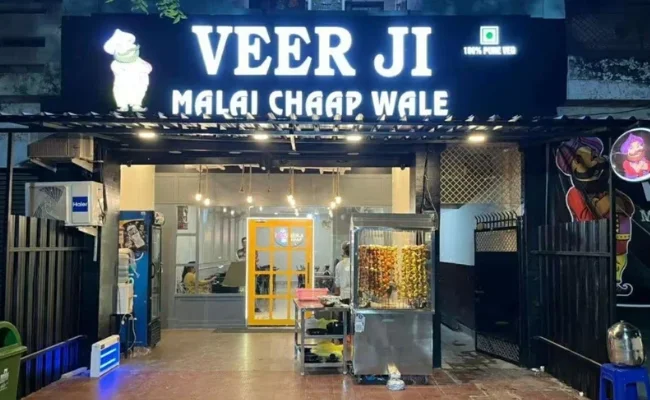
Starting a food startup like Veer Ji Malai Chaap is not about copying a dish—it is about building a scalable food brand that combines mass taste, operational simplicity, and franchise-ready economics.
Veer Ji succeeded because it solved a clear Indian market gap:
Vegetarian food that feels indulgent, meaty, affordable, and youth-oriented.
If you want to build a similar startup, you must think like a QSR founder, supply-chain strategist, and brand builder—not just a cook.
This article explains step-by-step how you can create your own startup like Veer Ji Malai Chaap, from idea validation to scaling across India.
First Principle: Don’t Copy the Dish, Copy the Model
Most failed food startups make this mistake:
“Chaap chal raha hai, main bhi chaap khol leta hoon.”
Veer Ji did NOT win because of chaap alone. It won because of:
- High-margin raw material (soya-based)
- Easy standardisation
- Youth-focused branding
- Franchise-ready operations
Your goal should be:
✔ Create a repeatable food system, not a one-time outlet
✔ Build a brand first, product second
✔ Design for scaling, not ego cooking
Step 1: Identify a Strong Food Concept (Like Chaap, But Yours)
A Veer Ji-like startup works only if the food has these 5 qualities:
| Requirement | Why It Matters |
| Vegetarian or semi-veg | Bigger Indian market |
| Low raw material cost | High margin |
| Customisable flavours | Menu expansion |
| Easy to train staff | Franchise scaling |
| Trend-friendly | Youth adoption |
Examples You Can Brainstorm:
- Plant-based kebabs / rolls
- Indian-style protein snacks
- Fusion tandoori concepts
- Grilled paneer or mushroom brands
- Affordable cloud-kitchen combos
Rule: If your food cannot be cooked by a 10th-pass kitchen helper in 7 days of training, it is not scalable.
Step 2: Build Unit Economics Before Branding
Before logo, Instagram, or influencer marketing—math comes first.
Ideal Small QSR Economics (Indian Reality):
| Parameter | Target |
| Average order value | ₹180–₹300 |
| Food cost | ≤ 40% |
| Gross margin | 55–60% |
| Staff cost | 10–12% |
| Rent | 8–12% |
| Net margin | 18–25% |
Veer Ji works because soya chaap costs are low, while perceived value is high.
Action for You:
- Test raw material cost daily
- Fix portion size strictly
- Eliminate waste ruthlessly
If unit economics don’t work at 1 outlet, they will never work at 100.
Step 3: Start Small, But Think Big (Pilot Outlet Strategy)
Veer Ji didn’t start with 100 outlets.
They likely started with:
- 1 outlet
- 1 city
- 1 clear customer segment
Your Pilot Outlet Should Be:
✔ 300–500 sq ft
✔ High footfall but low rent
✔ Simple menu (10–15 items max)
✔ Focused on takeaway & delivery
Do NOT over-invest.
Your first outlet is a testing lab, not a showroom.
Step 4: Create Standard Operating Procedures (SOPs)
This is where most Indian startups fail.
Veer Ji scaled because:
- Recipes were standardised
- Cooking steps were documented
- Training was system-driven
SOPs You Must Build:
- Raw material sourcing
- Food preparation steps
- Cooking time & temperature
- Hygiene & safety rules
- Staff behaviour & service flow
Golden Rule:
If your brand cannot run without you being present daily, it is not a startup—it is a job.
Step 5: Branding Like Veer Ji (But Ethically Smart)
Veer Ji used:
- Bold names
- Youth-friendly tone
- Memorable identity
You Should Focus On:
✔ Simple brand name (easy to pronounce)
✔ Strong colour identity
✔ Menu names people remember
✔ Instagram-friendly plating
Branding is not about luxury.
It is about recall + conversation.
Step 6: Delivery Platforms Are Not Optional
Veer Ji scaled in the era of:
- Swiggy
- Zomato
- Cloud kitchens
For Your Startup:
- Delivery must contribute 30–50% of revenue
- Menu must be delivery-friendly
- Packaging must protect quality
Without delivery optimisation, modern QSR brands die early.
Step 7: Prepare for Franchise Only After Proof
Do NOT rush into franchising.
Franchise-Ready Checklist:
✔ Minimum 12 months profitable operations
✔ Same taste across locations
✔ Centralised sourcing possible
✔ Training system documented
✔ Brand demand exists
Veer Ji monetises through:
- Franchise fees
- Royalties
- Supply chain margins
But franchising too early kills brands.
Step 8: Legal, Compliance & Structure (India Reality)
Before scaling:
- Register private limited company or LLP
- Get FSSAI, GST, local licenses
- Trademark your brand name
- Draft franchise agreement professionally
Many food startups collapse due to legal ignorance, not bad food.
Step 9: Funding – Bootstrap First
Veer Ji-type models work best when:
- Bootstrapped initially
- Profits reinvested
- Expansion funded by franchise partners
Avoid heavy VC funding early—it pushes unsustainable growth pressure.
Biggest Mistakes You Must Avoid
❌ Copying menu blindly
❌ Overspending on interiors
❌ No SOPs
❌ Expanding too fast
❌ Ignoring food cost control
❌ Running everything personally
Final Reality Check: Can You Really Build the Next Veer Ji?
Yes—but only if you understand this truth:
Veer Ji Malai Chaap is not a food success story.
It is a system + branding + unit economics success story.
If you:
- Respect numbers
- Build processes
- Focus on scalability
- Stay disciplined
You don’t need to copy Veer Ji—you can create your own Indian QSR success story.