
Veer Ji Malai Chaap Wale is one of India’s fastest-growing quick-service restaurant (QSR) brands focused on vegetarian soya chaap and related innovative plant-based foods. Founded by brothers Gurpreet Singh and Arvinder Singh, the brand has rapidly expanded into a major food chain with over 180 outlets across 13 states of India.
Value Proposition: Taste, Innovation & Mass Appeal
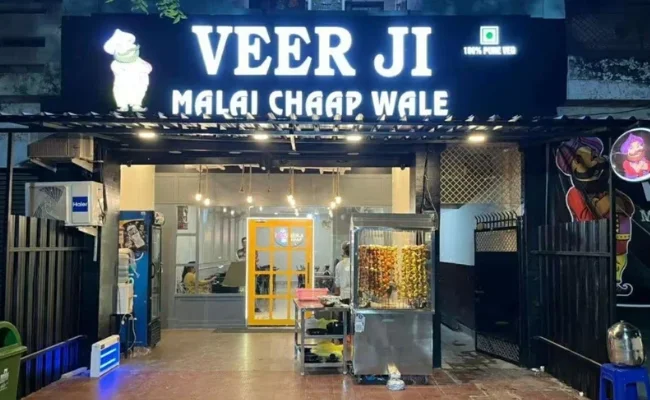
Unique Product Offering
Veer Ji Malai Chaap’s business strategy fundamentally rests on a distinct culinary value proposition:
- Vegetarian soya chaap dishes that mimic the taste, texture, and experience of non-veg cuisines.
- Menu items include creative, curious names like “Veg Chicken,” “Veg Fish,” Sunny Leone Chaap, Mia Khalifa Chaap and more — a blend of novelty with mainstream taste appeal.
This positioning solves a clear market need in India:
- Vegetarian customers who crave non-veg flavours, and
- Young customers attracted by fun branding and shareable experiences.
Revenue Streams
Veer Ji Malai Chaap earns money through multiple revenue streams:
🔹 Direct Sales from Outlets
Each outlet sells food directly to:
- Walk-in customers
- Takeaway customers
- Delivery orders via aggregators (Swiggy, Zomato)
Revenue here comes from food item sales, which are priced at QSR-friendly levels but with healthy margins. Aggregated sales per outlet can vary widely by location, but typical daily sales figures projected are ₹30,000–₹40,000 with monthly sales of ₹9–12 lakh.
🔹 Franchise Fees
The core of Veer Ji’s business model is its franchise expansion system:
- Franchise fee: ~₹10 Lakh + GST (non-refundable) per unit.
- Franchise agreement: usually 9 years.
- Royalty: 6% of gross sales (inclusive of GST).
This means the Veer Ji Malai Chaap earns upfront franchise income and recurring income from royalties on sales without direct operational involvement in each store.
🔹 Advertising & Brand Support Charges
In addition to the royalty, many franchise agreements include:
- Advertising levy (e.g., ₹20,000/year)
- Support fees collected by the central franchisor to fund marketing campaigns, brand development and consistent rollout strategies across regions.
Though smaller compared to the royalty, these fees contribute to a steady revenue mix and help fund national-level advertising.
Cost Structure & Margins
Understanding cost dynamics is critical for how the business makes money:
🔹 Cost of Goods Sold (COGS)
The main costs for individual outlets include:
- Raw materials (soya chaap, sauces, ingredients): about 40–45% of sales
- Rent, salaries, utilities and other operating expenses
- Royalty to franchisor (6% of sales)
After deducting these costs, typical gross margins range around 55–60%, with net margins of 20–25% for well-performing outlets.
This net profitability is attractive for a franchise model, making it viable for franchisees while ensuring the brand continues drawing recurring fees and royalties.
Franchise Expansion: Scalability & Network Effects
One of the biggest strengths of the business model is its scalability through franchising:
🔹 Franchise-Owned, Franchise-Operated (FOFO) Model
Under this model:
- Franchisees invest in setup and operations.
- The parent brand provides branding, training, SOPs, supply chains, and marketing support.
- Franchisees pay royalty and marketing fees but keep the majority (~90%) of revenue.
This allows the brand to expand rapidly without heavy direct capital expenditure.
🔹 Standardization & Control
To maintain consistent quality:
- Raw materials (especially frozen soya chaap) are supplied centrally or through approved channels.
- SOPs are enforced for food preparation and service.
- Brand aesthetics and operational systems are standardized.
Such measures ensure that each outlet strengthens the overall brand equity — which leads to higher sales and royalty earnings.
Marketing & Brand Positioning
Veer Ji Malai Chaap uses several marketing levers:
- Creative Naming & Menu Positioning (novelty items that generate word-of-mouth buzz).
- Celebrity Endorsements — e.g., brand ambassador Vindu Dara Singh adds visibility in premium markets.
- Social Media & Viral Messaging — focuses on Gen Z and social sharing.
- Aggressive Franchise Growth — more outlets equal market dominance and stronger brand recall.
This approach increases brand recognition and footfall — directly contributing to revenue across outlets and royalties from franchise partners.
Growth & Ecosystem Synergies
The company’s broader growth strategies include:
National Footprint
Over 170–180+ outlets across India — in Delhi-NCR, Punjab, UP, Rajasthan, Maharashtra, Karnataka, and beyond — creating scale and territorial recognition.
Diversified Menu
Beyond core chaap, the menu includes tandoori rolls, momos, biryani combos and beverages — increasing average order values and repeat purchase rates.
Strengthened Supply Chain
By operating a large centralized production facility, the company ensures quality while managing costs better — benefitting franchisees and improving profitability.
Conclusion
Veer Ji Malai Chaap has built a **business model that leverages:
- A niche but scalable product offering,
- Strong brand differentiation,
- Franchise-led expansion for capital-efficient growth,
- Multiple revenue streams (franchise fees, royalties, direct sales),
- Efficient cost structures enabling healthy margins.**
It essentially monetizes both brand equity and on-ground unit economics. With continued innovation and geographical expansion, it stands as a strong example of how a niche food brand can become a national chain using smart franchising and product strategy.